
Idiocracy is Here
How the worst conmen alive use the stupidest people you know to ruin everything


Terry Crews in Idiocracy (2006, Mike Judge)
According to recent reports, in the UK, Farage’s Reform Party accounts for similar voting intent percentages to the other main parties, is ahead of the Tories in every poll and was predicted to take more seats from Labour than the Tories. While polls are a snapshot rather than a reliable predictor of future election results, this should ring alarm bells in any reasonable person’s head, because Reform are a terrible and incoherent party dedicated to capturing the more politically correct far-right populist zeitgeist cultivated by Trump, the papers, Putin and the right of the Conservative Party, as well as longstanding memes from neonazi and modern fascist movements that filter their way through the propaganda laundries of the parties designed to give these people a more respectable front to vote for.
Here’s a seven-part essay on the issues as they came to me while writing this. While it is mainly aimed at a UK-based reader, many of these issues are either universal or also relevant to the US.
There is a real problem with societies becoming more stupid.
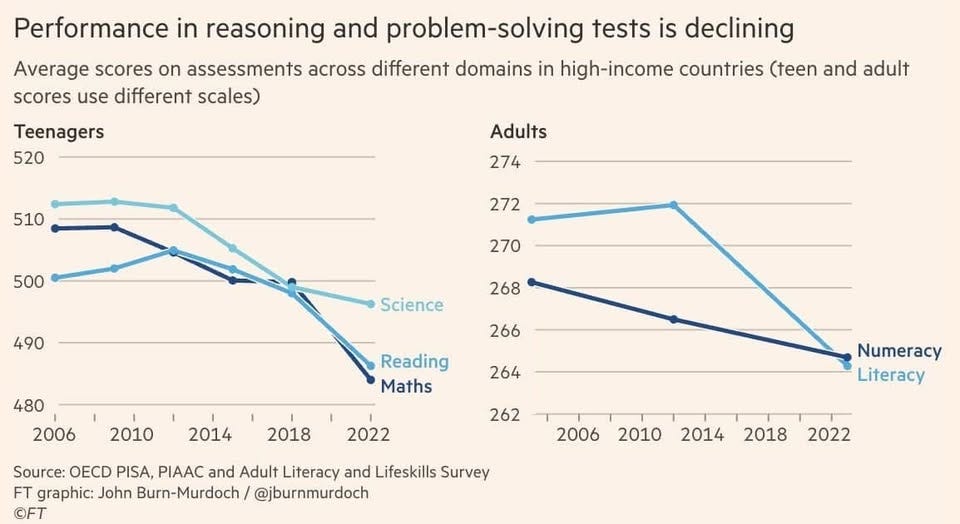
OECD: “Declines in literacy and numeracy proficiency were particularly evident among the least educated segments of the population. This led to a widening gap in skills proficiency between highly and low-educated adults in the majority of the participating countries and economies.”
These parties’s appeal relies on their ability to weaponise the stupid; the disaffected; the mindless controversy-seeking papers; the left-behind; the dipshit contrarians; the cruel; the hateful, bigoted and the unreasoning fearful. Despite being an implicit ‘revival of a glorious past’ party, they also want to push for all the stock policies of the populist right and the libertarians who become fascists overnight - almost certainly in exchange for funding and favours from noxious right wing groups and Putin overseas.
The Trumpian example and international Putinist far-right European coalitions, of which Reform is part, represent an existential threat to modern nations and economic and social stability.
There are many reasons societies become less educated, less literate, less numerate and less able to solve problems. Poverty is an obvious large factor in this, as this PDF by the National Literacy Trust shows. A lot of copy has been written about the adoption of social media on smartphones is a plausible factor in declining attention spans. The shift in the average smartphone usage from the early adopters, where users would taking an active role in finding information to more passive app formats that deluge the user with information in curated but extensive short packets, designed to hook the user in for longer lengths of time may also have a role. COVID-19 may have had neurological structural effects that made people more stupid by compromising neural pathways with neuronal and glial fusion, and lockdown isolation also had numerous negative effects on mental health and wellbeing.
GenAI is making things worse, too.
The advent of LLMs during the pandemic and the subsequent strong push by every single industry to find a use for them - has produced a new way to make people more credulous and bad at fact checking. Microsoft found (PDF) that:
“Specifically, higher confidence in GenAI is associated with less critical thinking, while higher self-confidence is associated with more critical thinking. Qualitatively, GenAI shifts the nature of critical thinking toward informationverification, responseintegration, andtaskstewardship. Our insights reveal new design challenges and opportunities for developing GenAI tools for knowledge work.”
With more GenAI slop appearing in every information source, it is going to be far too easy for truth, critical reasoning and proper sourcing to fall by the wayside. As of June last year, it was estimated that 10% of research was already being written by AI, and Elsevier was caught publishing research with the nonsense phrase “vegetative electron microscopy”:

Are you just being hysterical? How could they be an existential threat?
If Trump hadn’t just won in the US despite being known corrupt felon, sexual predator and fashy moron in his own right, the fact this was even a race at all is a startling indictment of the normal voter in the US.
I am not interested in the extensive post-mortem punditry around the issue saying that Harris not going on Rogan, or that she should’ve promised to stop Israel’s war in Gaza. The obvious problem is that no reasonable person would vote Trump regardless of Gaza, especially when Trump is much more clearly anti-Palestinian than Harris and the real consequences of putting Trump and Musk in power would be negative for Palestinians, Ukrainians, Americans and America’s allies. And yet millions voted, seemingly for exactly that, and is it right to call them unreasonable people, or stupid people?
The answer is yes. Absolutely yes. And it’s a fact I can’t get away from, although I know it is politically unthinkable to blame the electorate. But I am not a politician, I’m an analyst and a writer.
Why are you talking about America?
While the UK population did not vote in the American election, and our population is not as invested in exactly the same religions, ideologies and cultural touchstones as Americans. However, just because the cultures have differences, that doesn’t diminish the vast overlap, and the omnipresence of American media barons’ presence in British life, from social media and the NewsCorp legacy media. UK journalism has been in a poor state for years and now AI and Twitter’s use as a propaganda arm of the far right by Elon Musk is making disinformation, conspiracy theory and curated directions of travel for uneducated attitudes worse.
The threat to Britain is clear. There is a similar threat to Trump on the horizon; namely, the Reform Party, which Musk wishes to fund, along with repeated scumbag Tommy Robinson.
Any future electoral success of the Reform Party, and future disruption from divisive corrupt populists, will put absolute incompetents nearer to the levers of power and shift the tolerances around acceptable vibes in politics. It will put the welfare state and our assets as a nation in the hands of the most brazen AmericaCorp hedgefunds. Unlike the past, I earnestly believe that Reform is, like Trump and much of the Conservative Party, much less interested in what is best for the country regardless of ideology, versus what is best for their mishmash ideology and financial backers. Unfortunately, Reform voters are just not as interested in this as spiting and protest voting.
Meanwhile, the rise of Reform will encourage dehumanising and mistreating hated minorities across the aisles, as anti-trans feminists like JK Rowling and the Conservatives and various Labour feminists already did with trans people. The UK’s moral panic culture is clearly kith and kin to American moral panic culture, subject to similar propagation vectors, subject to the data powers in Silicon Valley, the felons in the White House and their craven oligarchical landscape and journalism. It would be entirely plausible to imagine a situation where the stupidity of British voters, led by Reform’s popularity as ‘the change party’ results a new position for Musk as part of allegiance in advance for the 2029 election. Obviously, Musk would be just as ruinous in Britain as he is in America.
The takeaway is that large sections of the British public, Reform, the Conservative Party and the activist right in Turton Street are sufficiently ignorant, stupid or malicious that pushing vibes and perception matter much more than facts and sound reasoning. By 2016 we reached the point that telling the public the truth didn’t change anything.
A Reform majority is still extremely unlikely
It’s unlikely that Reform will get a majority due to the first-past-the-post (FPTP) system. Great? Well, kinda. While this system works against smaller parties, disillusionment and the loss of faith in the system promoted by populists and poor governance can erode those leads, forcing coalition, hypocrisy and moderation. In principle, coalitions are not a terrible way to resolve intractably opposed public opinions - cooperation and pragmatism, the general justification for centrism. However, centrism doesn’t work if one of the sides is not playing by the same rules, if they are spreading lies and cruelty. It would be easy to anticipate a situation where the public would would vote for a situation where for any major party to rule, it would have to enter power-sharing coalitions, presumably Labour with Liberal Democrats and Reform with the Conservative Party. Both of these latter parties have attempted populist-right narratives and Reform in particular has little stomach for norms and genuine patriotism. Rather, they’re a murky organisation who are, like much of the European far right, likely associated with Putin, Musk and Trump.
Any Reform-influenced Tory government would likely follow the model set by Trump; they would strip the nation of its assets and reasonable plans for growth and investment. Short-termism and long-lasting damage can be anticipated, alongside massive corruption and the rolling back of civil rights. Concentration camps for asylum seekers, NHS privatisation and the dissolution of NATO while Russia expands are all plausible outcomes.
And you know someone who loves Farage would hear that and think it would be great.
Low-education, low-information voters are the architects and products of systemic failure and unreasoning hatreds, not just those who exploit them.
There is a significant presence of voters in the UK who seem specifically drawn to easy-answers that defines support for Reform, and before them, voting Leave in the Brexit referendum, voting for the Brexit Party, UKIP, the EDL and the BNP. This group is generally (but not exclusively) lower in educational attainment, and find greater appeal in political authoritarianism and anti-establishment conspiracism and logical fallacy.
In 2024, what were the results by party and education level? Luckily YouGov has asked this question:
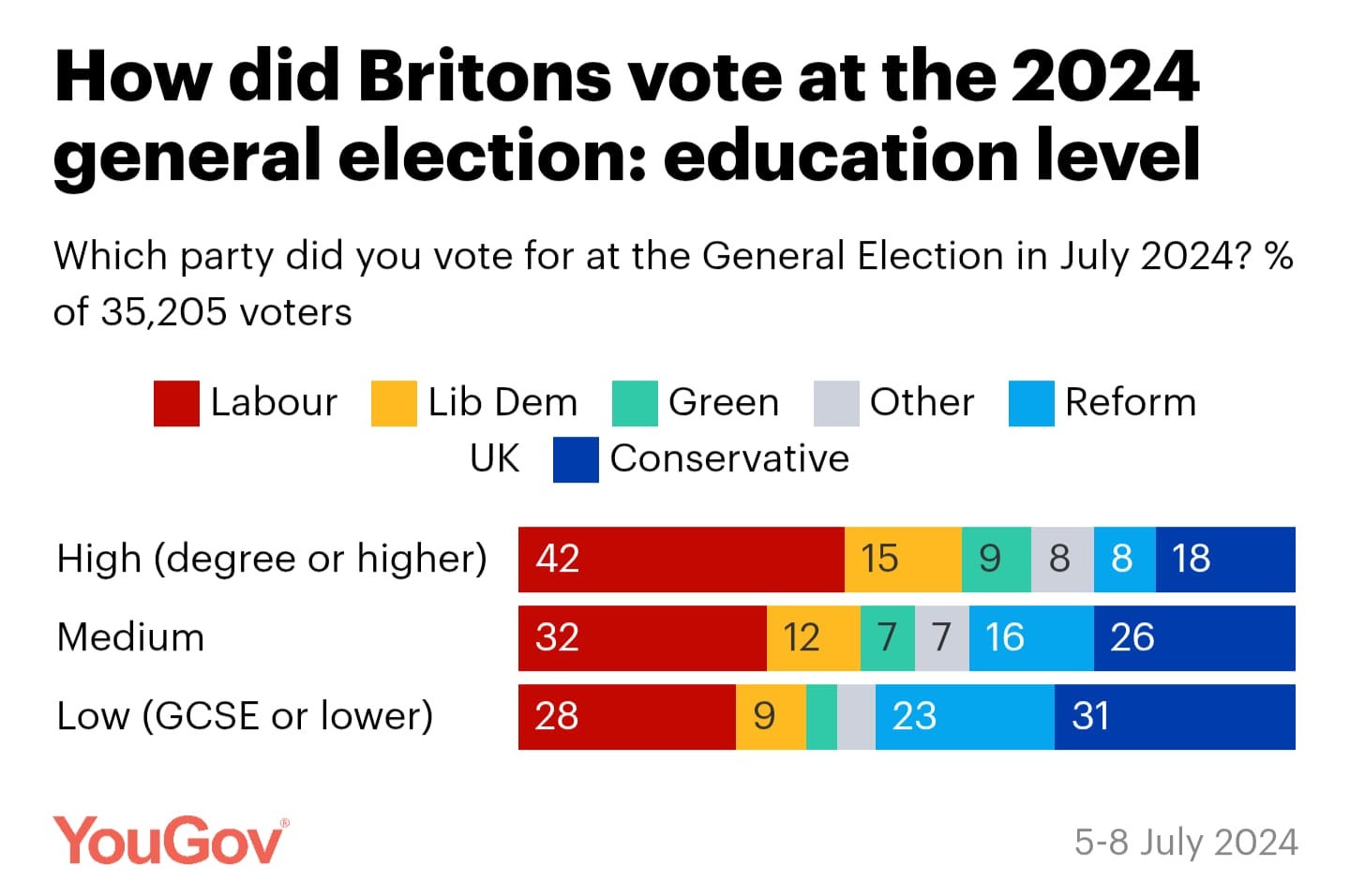
The above graph has a distinct trend - the higher the educational attainment, the lower the Reform and Conservative vote. Only the low (GCSE or lower) education had a majority answer for a combined Reform and Conservative vote.
While educational attainment is not a perfect indicator of what we might call “vulnerability to logical fallacies and poor decision-making due to trickery and disinterest in truth over vibes”. The reasons for the connection between educational level and poor judgement are complex and not easily reducible to anything innate about the individual. Obviously, there are people who are highly intelligent without degrees and there are people with PhDs who are terrible outside their area of expertise. However, education can impart a tendency towards critical-theoretical evaluative and dialectical approaches to claims. This is part of why further education is a thing at all—not just rote information, but being able to assess arguments in terms of logic and research, the themes behind them. Higher education does suggest a chance an individual has a kind of ‘informational hygiene’ that is likelier to reliably parse opinion and fact and therefore better evaluate sources of information.
As Elizabeth Simon from the Department of Social Statistics and Demography at the University of Southampton put it in this 2021 paper:
It is well established that educational attainment influences a plethora of attitudes and outcomes (Hainmueller and Hiscox, 2007; Surridge, 2016; Van De Werfhorst and De Graaf, 2004; Weakliem, 2002). In Western democracies, education is not only a potent source of social division but an emergent source of political division. Across Europe, nationalist and populist support comes primarily from the least educated and most green and social liberal party voters are graduates (Bovens and Wille, 2017). In 2016, Clinton held a 20 percentage point lead over Trump amongst graduates in the United States (PRC, Citation2018) and just 22% of United Kingdom (UK) graduates voted to leave the European Union (EU), compared to 72% of those with no qualifications (Curtice 2019.).
Recent civil unrest examples in the UK also corroborates these associations.
In 2011, rioters were found to be poorer, younger, less-educated, and in 2024 a lie on Twitter sparked a number of far right riots, including the attempted murder of a hotel full of asylum seekers. More than a quarter (29%) of rioters in 2024 came from the 10% of neighbourhoods with the lowest levels of qualifications. Within the rioting group, the overwhelming themes was of deprivation, low employment and low educational attainment, as well as social media. During these riots, the leader of Reform, Nigel Farage, boosted disinformation and Musk claimed civil war was ‘inevitable’.
Farage was condemned by then-leader of the Conservative Party, Tom Tugendhat as “irresponsible and dangerous”, and then Tugendhat went on to complain about DEI and Critical Race Theory.
Takeaway: the right is absolutely dependent on ageing voters and low-education voters.
What can be done?
This is the hardest thing to end on. On the face of it, it is a massive multifactorial problem and a threat to us all. In the UK, the impending death of Rupert Murdoch may herald a shift in hateful information flow to the stupid. Poverty reduction and access to education are obvious priorities that everyone really knows already.
We need to increase socialisation among the isolated as soon as possible, and likely intervene somehow with social media as it is currently arranged. Funding alternative protocols for knowledge that are billionaire-proof may become more important. Socially rejecting a lot of GenAI and social media as consumers may help too. Prompting disgust for stupidity, racism and ‘just asking questions’, or watching Andrew Tate may be helpful like it was for smoking. Holding people responsible for their claims, demanding people who speak be educated on what they’re talking about, and not reaching across the aisle to people who are gaming the system are all going to be important strategies in what is an informational and socio-behavioural culture war.
These are just some spitballed ideas but this essay is far too long anyway. Good luck.